News
What We’re Learning from the Phygital Fellows
Mar 24, 2026
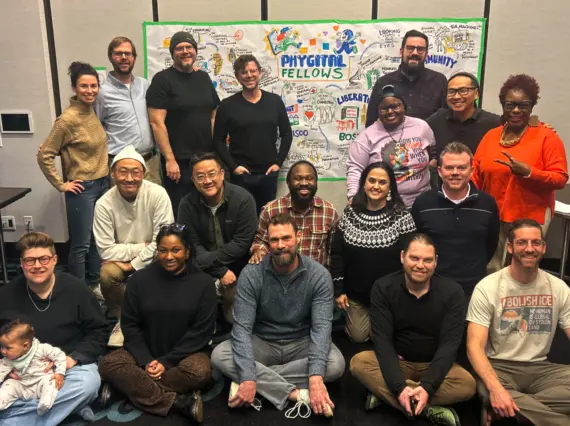
Soul, technology, and the evolving practice of pastoral leadership
For many congregations, digital ministry began as livestreaming worship or sharing sermon clips online.
But one of the most interesting lessons emerging from the Phygital Fellows — a group of pastors and innovators experimenting with new forms of ministry — is that the real work isn’t primarily about technology.
It’s about soul.
Recently, Phygital Fellow Rev. Dr. Jess Beilman reflected on his experience in the cohort and what it has meant for his ministry. What surprised him most wasn’t learning platforms or digital strategy. It was discovering that digital spaces can become real places of pastoral imagination, spiritual formation, and community.
Jess’s story began simply: a meditation practice he started on the Insight Timer app while he was between ministry settings. At the time, he didn’t think of it as digital ministry.
It was just ministry.
A few hundred people found their way to it. He kept going.
Through the fellowship, that small experiment has grown to more than 2,000 participants and has sparked a new initiative Jess is launching called Project 2045, helping white Christians develop the spiritual formation needed for a multicultural future in which the United States will no longer be majority white.
The digital tools didn’t create the calling. They simply gave it room to grow.
Jess’s story points to something larger unfolding across the cohort. As we’ve read and reflected on the fellows’ projects, a few signals are beginning to emerge that may matter for congregational leaders:
1. Digital ministry is becoming a real field of pastoral practice.
For many clergy, digital work has often felt like something added alongside the “real” ministry of the church. But increasingly, it is becoming a primary environment for ministry.
People pray online. They form community online. They seek guidance and spiritual formation online. Pastoral relationships now extend across both physical and digital spaces.
The question for church leaders is no longer whether digital ministry will exist. The question is how pastors will practice pastoral care and spiritual leadership within it.
2. The medium shapes the imagination.
One surprising insight from the cohort is that new tools often unlock new creativity.
When pastors begin experimenting with podcasts, apps, Substack communities, or online cohorts, they often find themselves reimagining what ministry can look like.
Ancient wisdom doesn’t disappear in these spaces. It finds new containers. The Christian tradition remains the source. But new mediums create new ways for that tradition to move.
3. The deepest question isn’t technology — it’s formation.
Throughout the cohort, one theme kept resurfacing. Not strategy. Not platforms.
Soul.
Again and again, fellows found themselves returning to the old Wesleyan question: How is your soul?
The work of ministry — whether in sanctuaries, neighborhoods, podcasts, or digital communities — still revolves around that central pastoral task: helping people tend their souls in a changing world.
Technology may reshape the setting. But the calling remains the same.
The work ahead
Perhaps the most important insight from the Phygital Fellows is this: the future of ministry is not confined to a single form. It is taking shape both within the traditional structures of the church and alongside them in new digital spaces.
Some leaders will continue to cultivate this work within institutions. Others will explore new expressions beyond them.
What matters is not the setting, but the substance — whether the church is creating spaces where souls are tended, communities are formed, and imagination for the gospel can grow in ways that are faithful to this moment.
Increasingly, that work will be both physical and digital.
Or as the fellows have begun to call it: phygital.
Where are you being called to create space for souls to be tended and community to take shape—across both the physical and digital realities of your ministry?